Parkinson’s disease (PD) is a progressive neurodegenerative disorder with a lengthy prodromal phase that remains difficult to capture using traditional clinical tools. Most monitoring begins only after diagnosis, limiting insight into early symptoms and the lived experience of disease progression. In this talk, I will present work evaluating Facebook as a novel, longitudinal data source for studying PD-related disclosures across the disease timeline
-from years before diagnosis to later stages.
The increasing burden of mental health disorders-including depression, anxiety, OCD, and suicidal ideation-necessitates the development of advanced Al frameworks capable of interpreting complex emotional signals from language. Our research focuses on context-aware large language models (LLMs) that capture nuanced emotional and psychological patterns embedded in long, unstructured text. These models are designed to preserve semantic coherence and context across sequences, enabling more accurate detection of early mental health risk factors. We introduce a multi-task representation learning approach that integrates subject specific and context-specific features for detecting a range of mental health conditions from both psychiatric and social media texts. This strategy allows for task-specific adaptation while maintaining shared representations, enhancing generalization across related emotional and behavioral tasks. A key aspect of our work involves Hierarchical Explainable Al (XAI), where we employ layered attention mechanisms and graph-based interpretability techniques to identify critical risk-inducing patterns in suicidal and emotionally volatile texts. The framework not only highlights word-level and sentence-level importance but also models higher-order semantic dependencies across text segments, offering transparency in sensitive decision-making contexts. Our current direction explores the use of Explainable Graph Attention Networks and Deep Q-Learning to identify high-risk emotional states and generate context-aware intervention strategies. We further envision the integration of generative Al for producing personalized, real-time supportive responses. Future extensions involve multimodal LLMs that combine text, image, and genetic data for a more holistic understanding of mental health.
Amid the recent uptake of Generative Al, sociotechnical scholars and critics have traced a multitude of resulting harms, with analyses largely focused on values and axiology (e.g., bias). While value- based analyses are crucial, we argue that ontologies-concerning what we allow ourselves to think or talk about-is a vital but under-recognized dimension in analyzing these systems. Proposing a need for a practice-based engagement with ontologies, we offer four orientations for considering ontologies in design: pluralism, groundedness, liveliness, and enactment. We share examples of potentialities that are opened up through these orientations across the entire LLM development pipeline by conducting two ontological analyses: examining the responses of four LLM-based chatbots in a prompting exercise, and analyzing the architecture of an LLM-based agent simulation. We conclude by sharing opportunities and limitations of working with ontologies in the design and development of sociotechnical systems.
Adversarial text-carefully crafted inputs designed to mislead or degrade the performance of NLP systems-poses a growing challenge across a range of language technologies. In this talk, I will present my work on adversarial text detection and methods for improving the quality and stability of such texts once identified. / will discuss the linguistic and structural characteristics of adversarial inputs, outline current approaches for automatic detection, and introduce techniques for refining adversarial examples to make them more semantically coherent. While the primary focus will be on traditional NLP systems, / will also reflect on how these techniques might evolve to address the emerging complexities of large language models (LLMs). Looking ahead, / will highlight how adversarial methods could be leveraged not only for defence but also as diagnostic tools for probing and improving LLM robustness, interpretability, and trustworthiness.
When people comprehend, interpret, or communicate about their environment, they draw on “mental schemata” that encode common knowledge and associations based on experiences, moral values, or beliefs.
New information that aligns with existing mental schemata is much more readily understood and accepted. This talk will present two projects that explore the manifestation of media framing, and moral understanding in humans in LLMs. First, / will introduce “narrative media framing,” a conceptualization of framing grounded in the social sciences that links media framing devices with cognitively salient narrative representations. Secondly, I will present our recent work where we propose a robust method for probing representations of morality in LLMs through word associations.
No artificial intelligence (Al) has yet been scientifically recognized as sentient. However, the concept of “sentient Al” continues to evoke a spectrum of fears-from valid concerns to misconceptions shaped by fiction. To distinguish genuine risks from misperceptions, I introduce a dual-index framework. The Sentience Index measures an Al’s objective sentience-relevant capacities, while the Human Perception Index measures the gap between reality and human perception of Al sentience, shaped by individual and collective narratives. This approach transforms fear into informed action by fostering evidence-based, philosophically grounded discourse on Al sentience and preparing society for its ontological and ethical implications.
Recent large language models (LLMs) support long contexts ranging from 128K to 1M tokens. A popular method for evaluating these capabilities is the needle-in-a-haystack (NIAH) test, which involves retrieving a “needle” (relevant information) from a “haystack” (long irrelevant context). Extensions of this approach include increasing distractors, fact chaining, and in-context reasoning.
However, in these benchmarks, models can exploit existing literal matches between the needle and haystack to simplify the task. To address this, we introduce NoLiMa, benchmark extending NIAH with a carefully designed needle set, where questions and needles have minimal lexical overlap, requiring models to infer latent associations to locate the needle within the haystack. We evaluate 12 popular LLMs that claim to support contexts of at least 128K tokens.
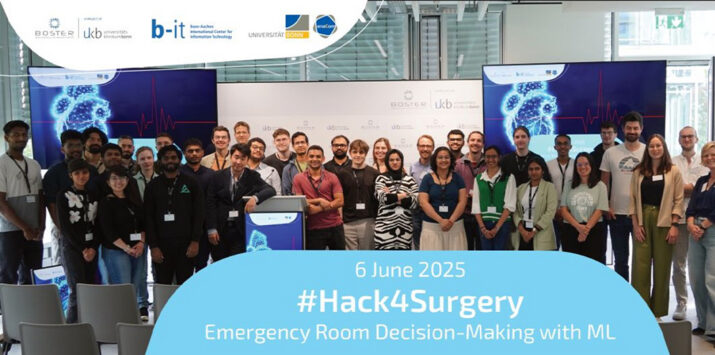
The hackathon at the Bonn Surgical Technology Center (BOSTER) of the University Hospital Bonn (UKB) brought together participants to explore the role of machine learning in medicine using real clinical data. Prof. Fröhlich from b-it and his team supported the event as advisors and jury members, emphasizing the educational value and impressive outcomes for the students.
On June 23 and 24, 2025, the second edition of “AI in the Life Sciences – An Industry Symposium” will take place at Schloss Birlinghoven in Sankt Augustin, Germany. The symposium, organized by Fraunhofer SCAI and the Bonn-Aachen International Center for Information Technology (b-it), brings together leading experts in artificial intelligence (AI) and life sciences.
Large Language Models (LLMs) are often seen as powerful yet static entities, their knowledge frozen after training, disconnected from the ever-evolving world. In this talk, we will explore the challenge of updating these models without retraining them from scratch. We’ll examine current techniques such as fine-tuning, parameter-efficient methods (PEFT), Retrieval-Augmented Generation (RAG), and model editing approaches like Elastic Weight Consolidation (EWC), each with its own trade-offs in scalability, consistency, and memory retention.
This site uses essential cookies (always active for basic functions) and optional cookies for analytics. We respect your privacy under GDPR – choose to accept or reject non-essential cookies. See our Data Protection for details on your rights.