Artificial Intelligence is achieving increasingly impressive results in drug discovery. Yet as these models become more powerful, they also raise a fundamental scientific question: when do they produce reliable scientific insights, and when do they merely generate plausible predictions?
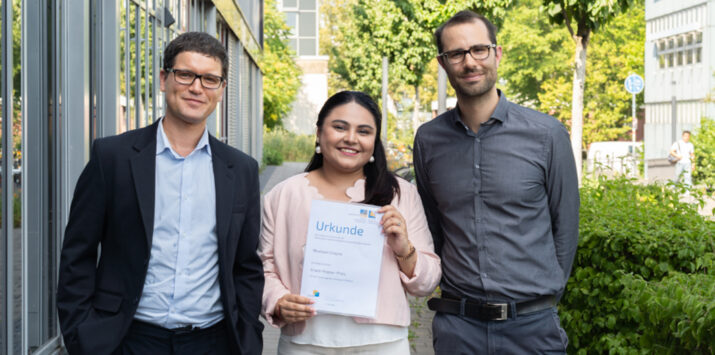
We are delighted to share some exciting news: Muskaan Chopra has been awarded the Grace Hopper Award by the Institute of Computer Science at the University of Bonn.
This is a short summary of our paper “History Rhymes: Macro-Contextual Retrieval for Robust Financial Forecasting” by Sarthak Khanna, Armin Berger, Muskaan Chopra, David Berghaus, and Rafet Sifa, published in the proceedings of the 2025 IEEE International Conference on Big Data.
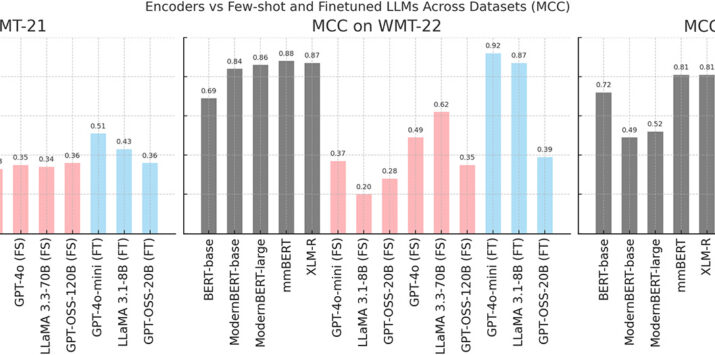
This is a short summary of our paper “Towards Reliable Machine Translation: Scaling LLMs for Critical Error Detection and Safety” by Muskaan Chopra, Lorenz Sparrenberg, and Rafet Sifa, published in the proceedings of ECIR 2026.
This is a short summary of our paper “From Retinal Pixels to Patients: Evolution of Deep Learning Research in Diabetic Retinopathy Screening” by Muskaan Chopra, Lorenz Sparrenberg, Armin Berger, Sarthak Khanna, Jan H. Terheyden, and Rafet Sifa, published in the proceedings of the 2025 IEEE International Conference on Big Data.
This is a TL;DR of our paper “Benchmark Success, Clinical Failure: When Reinforcement Learning Optimizes for Benchmarks, Not Patients” by Armin Berger, Manuela Bergau, Helen Schneider, Saad Ahmad, Tom Anglim Lagones, Gianluca Brugnara, Martha Foltyn-Dumitru, Kai Schlamp, Philipp Vollmuth, and Rafet Sifa, available on arXiv and to be published in the Proceedings of IJCNN 2026.
This is a short summary of our paper “Leveraging Synthetically Generated Data for Real Estate Document Classification” by Tobias Deußer, Gregor Ramien, Nico Weber, Maximilian Meidinger, Max Hahnbück, Christian Bauckhage, and Rafet Sifa, published in the proceedings of the 2025 IEEE International Conference on Big Data.
This is a short summary of our paper “Towards Automated Recipe Reconstruction: Optimization of Dietary Data Collection using Information Retrieval, Large Language Models and Mathematical Optimization” by Svetlana Schmidt, Linda Klasen, Ute Nöthlings, and Rafet Sifa published in the proceedings of the 2025 IEEE International Conference on Big Data.
On June 23 and 24, 2025, the second edition of “AI in the Life Sciences – An Industry Symposium” will take place at Schloss Birlinghoven in Sankt Augustin, Germany. The symposium, organized by Fraunhofer SCAI and the Bonn-Aachen International Center for Information Technology (b-it), brings together leading experts in artificial intelligence (AI) and life sciences.
This site uses essential cookies (always active for basic functions) and optional cookies for analytics. We respect your privacy under GDPR – choose to accept or reject non-essential cookies. See our Data Protection for details on your rights.